Journal Prompts: Daily Ideas for Reflection, Plus How to Journal With AI Chat
77 journal prompts by time of day, theme and season, plus how to turn daily journal prompts into a guided session in Omnely chat. You write; chat asks.

Below are 77 original journal prompts, grouped by time of day, theme and season, written so each one can carry a five- to fifteen-minute writing session, plus a short method and four real examples of using Omnely chat as a reflection partner that asks questions one at a time. This is reflective writing and noticing on paper, in a notes file or in a document. The AI never writes the entry; the reader does.
If a prompt sits well on the page, copy it and go. If a session feels better, paste the prompt below into Omnely chat and answer one question at a time. The first set of daily journal prompts starts right after this; later sections cover morning, evening, weekly review and seasonal journaling prompts for late 2026 and the turn into 2027.
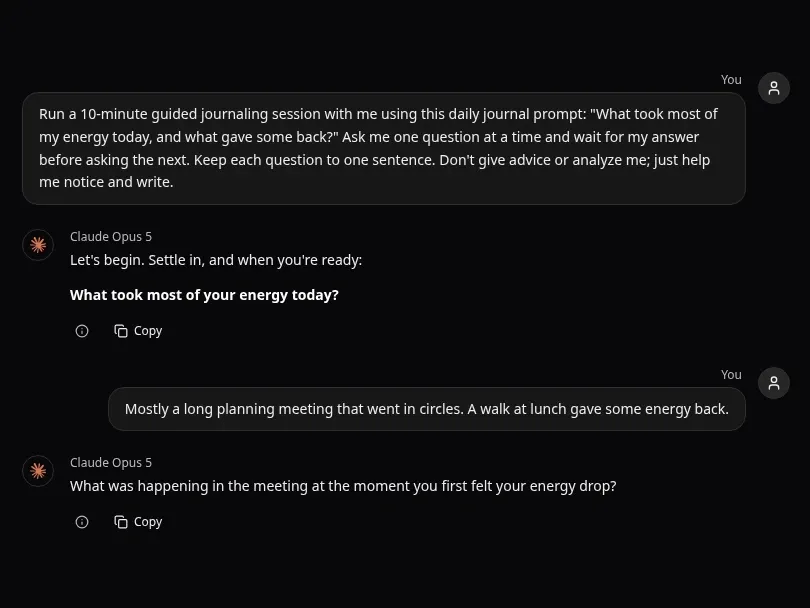
Run a 10-minute guided journaling session with me using this daily journal prompt: "What took most of my energy today, and what gave some back?" Ask me one question at a time and wait for my answer before asking the next. Keep each question to one sentence. Don't give advice or analyze me; just help me notice and write.Paste that into Omnely chat with Claude Opus 5 selected. The model opens with a single question, waits, and asks one follow-up based on the answer.
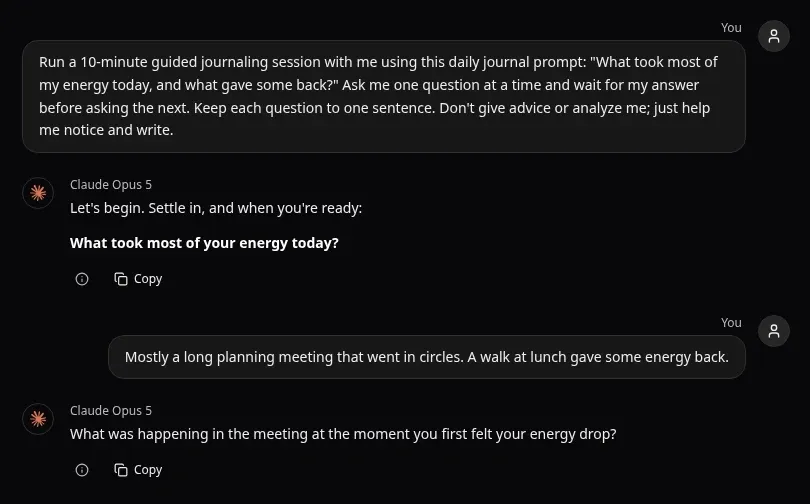
Claude Opus 5 asked a single question first, then, after a one-line answer about a planning meeting and a lunch walk, asked one follow-up about the moment energy dropped, and gave no advice.
Try it with Claude Opus 5 in Omnely chat — new users get free credits, and Claude Opus 5, GPT-6 Astra and Gemini 3.1 Pro each need a paid Omnely plan.
Journal prompts by time of day, theme and season
Seventy-seven original prompts, grouped into eleven sets. Pick one that fits the moment and write.
Quick daily journal prompts (5-minute, any day)
Short openers for days when a full page feels like too much. Each one is designed to be answerable in three to five lines.
1. Name the first thing that caught your attention this morning and describe why your eye stopped on it.
2. Write the sentence you keep almost saying today but have not said out loud.
3. What is the smallest decision you made today, and what did it decide against?
4. Describe the weather as if explaining it to someone who cannot look outside.
5. List three objects within arm's reach and one true sentence about each.
6. What phrase have you heard more than once this week, and from whom?
7. If today were a chapter in a book, write its one-line chapter title.
Morning journal prompts
For the first thirty minutes of the day, before messages take the wheel. Keep answers short so the writing does not eat the morning.
1. What is the first task that deserves your clearest attention today, and why that one?
2. Name one person you expect to speak to today and the tone you want to bring to that conversation.
3. Describe the room you are sitting in using only sounds.
4. What is one small thing from yesterday that is making this morning easier?
5. Which part of today are you quietly looking forward to?
6. Write a single sentence you would like to be able to say honestly at the end of the day.
7. What is one thing you will not try to finish today?
Evening journal prompts
Short reflections to close the day without turning into a review of every hour.
1. What is the last thing that made you laugh today, even a little?
2. Describe one moment when time seemed to move faster than usual.
3. What did you learn today that you did not know at breakfast?
4. Write about a conversation that is still in your head, without resolving it.
5. Name one thing you handled better today than you would have a year ago.
6. What is one loose end you are choosing to leave for tomorrow on purpose?
7. Describe the light in the sky when you first noticed the day was ending.
Gratitude journal prompts
Specific, grounded, and past the "list three things" reflex.
1. Write about a tool or object you use almost every day and would miss if it broke.
2. Name a small kindness a stranger did for you this month and describe exactly what they did.
3. What is a food you ate this week that someone took time to prepare, and what did you notice about it?
4. Describe a place in your neighborhood you are glad exists, and what would change if it closed.
5. Who taught you the specific skill you used most this week?
6. Write a short thank-you note you will not send, to someone who will not read it.
7. What is a sound in your home you associate with being at home, and when did you last notice it?
Self-discovery journal prompts
Values, preferences and curiosity. Nothing clinical.
1. Describe a topic you could talk about for an hour without running out of things to say.
2. What is a rule you were given as a child that you have quietly stopped following?
3. Name something you used to find boring that you now find interesting, and when the switch happened.
4. Write about a compliment that stuck with you and why it landed.
5. What do you spend time on that you would not want to have to justify to a stranger?
6. Describe the kind of workday that leaves you tired in a good way.
7. What is a question you would like someone to ask you, and how would you answer it?
Goals and habits journal prompts
For checking a direction without making a new five-year plan.
1. What is one project you started this year that is still alive, and what has kept it alive?
2. Describe a habit that has moved from effort to automatic in the last six months.
3. What is a goal from January that has quietly changed shape, and what does it look like now?
4. Name one thing you have been meaning to start, and write what the first ten minutes of it would look like.
5. What do you keep saying "later" to, and what would "this week" require?
6. Which habit costs you energy you would rather spend elsewhere?
7. If you kept doing exactly what you did this week for a year, what would be different?
Memories and childhood journal prompts
Specific scenes, not life summaries. Write one memory at a time.
1. Describe the kitchen of a house you lived in before the age of twelve.
2. Write about a game you invented as a child and the rules you remember.
3. Name a teacher whose face you can still picture, and one thing they said.
4. What was the first piece of music you chose for yourself, and where were you when you heard it?
5. Describe a walk you took often as a child, step by step, from door to destination.
6. Write about a smell from a grandparent's or older relative's home.
7. What was a small ritual in your family that you only realised was unusual later?
Creativity and writing journal prompts
Descriptive scenes, letters and lists to warm up a writing hand. For verse, see Poetry Prompts; for sketch-journaling pages, see Drawing Prompts; the full index lives at AI Prompts.
1. Write a one-paragraph description of an ordinary room as if it were a stage set.
2. Draft a letter to a version of yourself one year ago, with no advice, only news.
3. List ten things you overheard this week, verbatim or close to it.
4. Describe a stranger you saw today in enough detail that another reader could draw them.
5. Write a short scene set entirely in a waiting room, with no dialogue.
6. Pick a colour and write a paragraph that uses it four times without repeating the sentence structure.
7. Describe the last meal you cooked as if writing the first page of a short story.
Relationships and people journal prompts
Warm and observational. Write about people as they actually move through your days.
1. Describe a friend by the way they enter a room.
2. Write about the last phone call you made that lasted more than fifteen minutes.
3. Name a colleague you have learned something from this year, and what it was.
4. Describe a family member's laugh in enough detail that you could recognise it in the next room.
5. Write about a short interaction with someone you may never see again.
6. What is a small habit of someone close to you that you have grown fond of?
7. Describe a gesture a person you love makes without thinking.
Weekly and monthly review journal prompts
Longer prompts to close a week or a month and point at the next one.
1. Write a brain dump of everything that actually happened this week, in any order.
2. Which three events from this month took up more space in your head than their size?
3. What did you spend time on this week that you would do again next week without hesitation?
4. Write about one friction point from the month and what it kept bumping into.
5. What is one thing you expected to be hard this week that turned out to be fine?
6. Name one unfinished item to carry over to next week and one to let go of.
7. What is the single most important focus for the coming week, in one sentence?
Seasonal and year-end journal prompts
Late autumn, Thanksgiving week, December, and the turn from 2026 into 2027.
1. Describe the first morning this autumn that genuinely felt like autumn.
2. Write a short list of the foods you want to be eating in the next six weeks and why each one.
3. For Thanksgiving week, name one person outside your household you want to thank in writing before the year ends.
4. What has 2026 asked of you that 2025 did not?
5. Describe one scene from this December that you would like to remember next year at this time.
6. Looking back at 2026, name one thing that turned out better than the version you expected in January.
7. Looking ahead to 2027, write a single sentence about the kind of month January could be if it went well.
How to use a journal prompt
Pick one prompt that matches the moment — a morning one before the day starts, a review one on a Friday, a seasonal one in the week between Christmas and New Year. Set a timer for five to fifteen minutes. Write without editing, cross-outs welcome, spelling unfussed. Stop when the timer stops, even mid-sentence. If the prompt does not fit, skip it and pick another; forcing a prompt that does not land usually produces a thin page.
Paper, a plain notes file, a document, a fresh page in a notebook — any of them work. At the end, if there is energy for one more line, add a single sentence about what you want to try tomorrow. That is the whole method. The list above is a menu, not a schedule, and missing a day is not failing anything.
Turn a journaling prompt into a guided session in Omnely chat
Omnely is an AI workspace with chat, image, video and audio models, not a journaling app. The reader keeps the actual entry wherever they normally write. What chat is good for is a rhythm: the model asks a short question, the reader writes an answer in their own notebook or file, the model asks the next one. Four real examples follow.
1. One question at a time (Claude Opus 5)
The session at the top of this page shows this pattern end to end: a single opening question, a wait, and one follow-up shaped by the answer. The one-line reply during that session looked like this, and that was enough for the model to continue:
Mostly a long planning meeting that went in circles. A walk at lunch gave some energy back.Short answers are fine. The model does not need a paragraph to ask the next question.
2. A morning set built for a busy day (GPT-6 Astra)
For mornings when there is no time for a long session, ask a chat model for a tight set of one-line prompts to choose from.
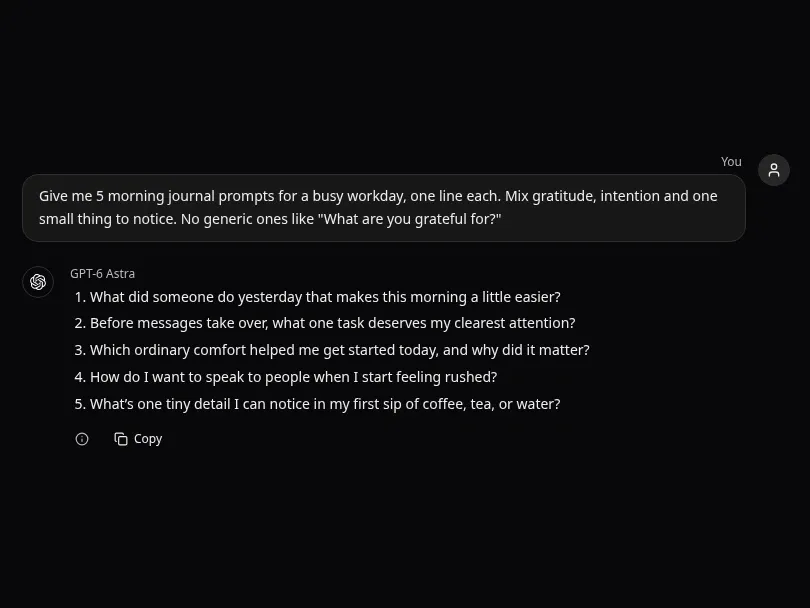
Give me 5 morning journal prompts for a busy workday, one line each. Mix gratitude, intention and one small thing to notice. No generic ones like "What are you grateful for?"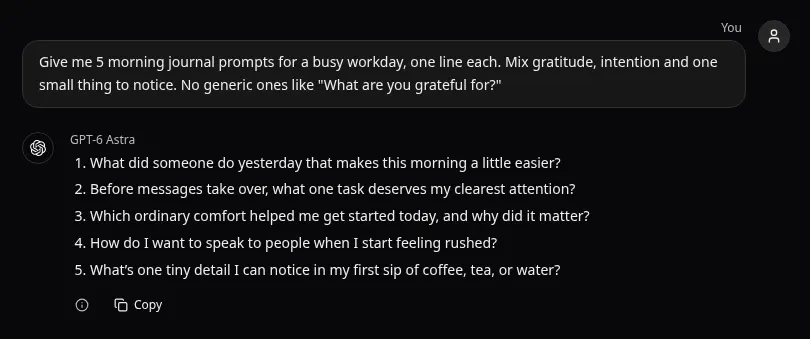
GPT-6 Astra returned five one-line morning prompts mixing a thank-you, one focus task and a small sensory detail, and skipped the generic gratitude question as asked.
3. A 15-minute end-of-week review (Gemini 3.1 Pro)
On Fridays, a structured review works better than a blank page. Ask for an ordered set with time estimates and keep the answers in your own notebook.
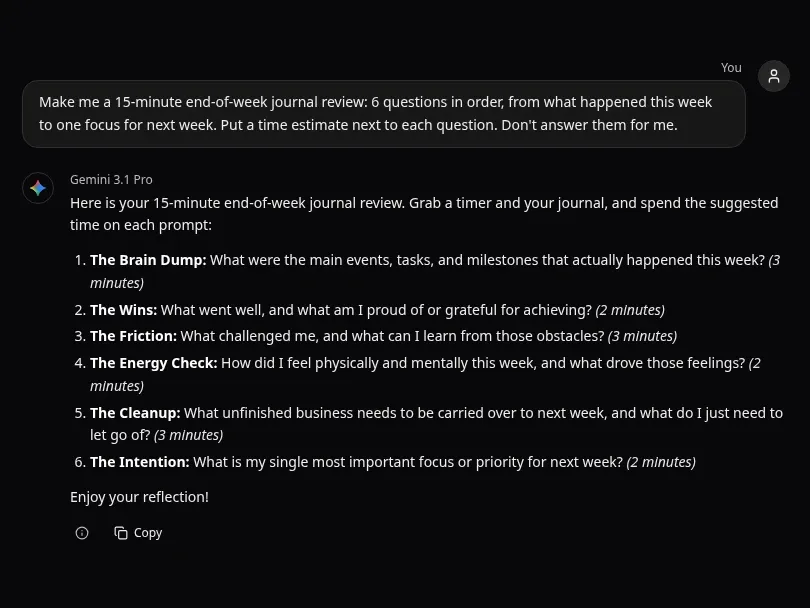
Make me a 15-minute end-of-week journal review: 6 questions in order, from what happened this week to one focus for next week. Put a time estimate next to each question. Don't answer them for me.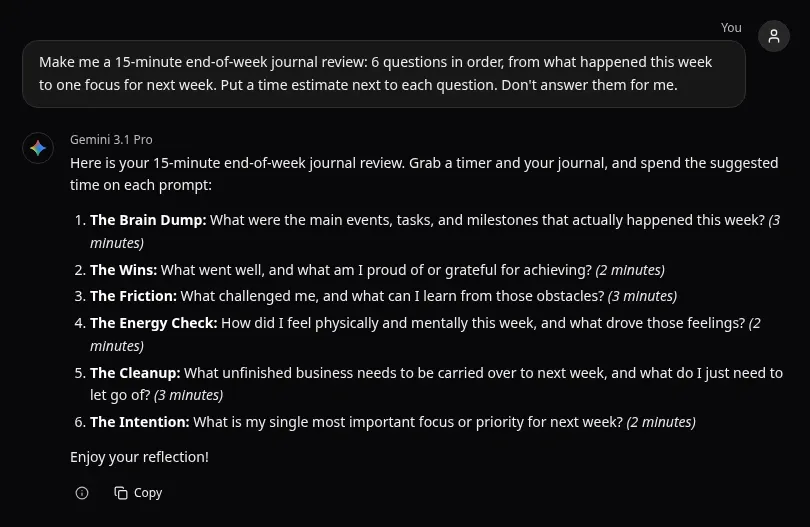
Gemini 3.1 Pro returned six ordered questions, from a brain dump of the week to one focus for next week, with time estimates adding up to 15 minutes, and did not answer them.
4. Turning an ordinary moment into a scene (Claude Opus 5)
Descriptive writing is easier after a short interview about sensory details. Ask the model to interview you, then write the scene yourself.
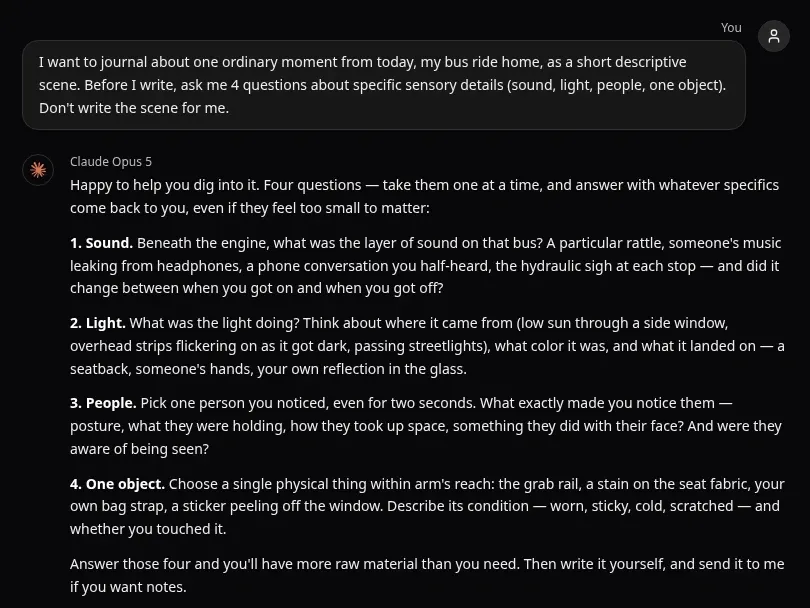
I want to journal about one ordinary moment from today, my bus ride home, as a short descriptive scene. Before I write, ask me 4 questions about specific sensory details (sound, light, people, one object). Don't write the scene for me.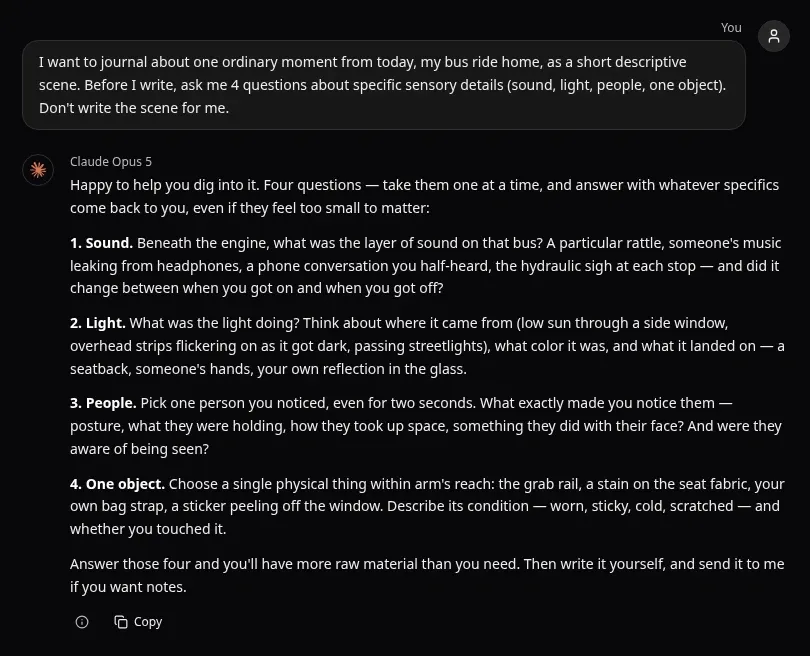
Claude Opus 5 asked four sensory questions (sound, light, one person, one object) and told the reader to write the scene themselves, offering notes afterwards; it did not write the scene.
Claude Opus 5, GPT-6 Astra and Gemini 3.1 Pro sit in the same Omnely chat model picker alongside other models; open Claude Opus 5 in Omnely chat and paste any prompt from this page. These models need a paid Omnely plan; new users get free credits.
Chat is a writing aid for reflection and not a substitute for professional support.
Print a prompt card or decorate a journal cover (optional)
For a paper setup, a single-prompt card on the desk or inside the cover of a notebook is a nice nudge. Omnely's image models can make one. Ideogram 4.5 handles text on images cleanly, which makes it a good fit for a readable prompt card or a cover with a title like "Mornings, 2027." GPT Image 2 works well for a softer illustrated cover without on-image text — think a quiet landscape or a still-life from one of the memory prompts above. Keep the text short, pick one prompt, print and tape.
Journal prompts FAQ
What are journal prompts?
Journal prompts are short questions or instructions that give a writing session a starting point. Instead of staring at a blank page, the writer answers one specific question — "Describe the first morning this autumn that genuinely felt like autumn" — for a set amount of time. Journal prompts and journaling prompts mean the same thing: a way to begin, not a form to fill in.
How many prompts per day is enough?
One is enough. A single prompt answered for five to fifteen minutes is a complete session; three prompts answered in a hurry usually produce thinner pages than one answered with attention. On review days — Friday or the last day of the month — a short ordered set, like the six-question review above, works better than a single prompt.
Daily journal prompts vs weekly review: which to use when?
Daily journal prompts are short and narrow — one moment, one feeling, one observation from the last twenty-four hours. Weekly and monthly review prompts zoom out and ask about patterns, carry-overs and the next focus. A simple rhythm is a short daily prompt most days and one longer review at the end of the week.
Should a chat model write the entry for the reader?
No. The chat model asks questions, suggests structure, or interviews the writer about sensory details; the reader writes the entry. The transcripts on this page show the pattern: Claude Opus 5 waited for an answer before asking the next question, Gemini 3.1 Pro left its review questions for the reader to answer, and in the scene exercise Claude Opus 5 ended with "write it yourself." The writing is the point.
Pick one prompt from the list above — a quick daily one, a morning set, a Friday review, a seasonal line about 2026 or 2027 — or paste the guided session from the top of this page into Claude Opus 5 in Omnely chat and answer one question at a time. The chat models shown here need a paid Omnely plan, and new users get free credits.