Poetry Prompts: Ideas for Every Form, Plus How to Draft With AI Chat
60 poetry prompts grouped by form and theme, plus how to draft with AI chat on Omnely. Write the poem yourself; use chat as a writing partner.
This page collects about 60 original poetry prompts, grouped by form and theme, for you to write — plus four real Omnely chat transcripts that show how to use a model as a writing partner, not a poem generator. The list comes first. The chat section comes after, so the writing stays in your hands.
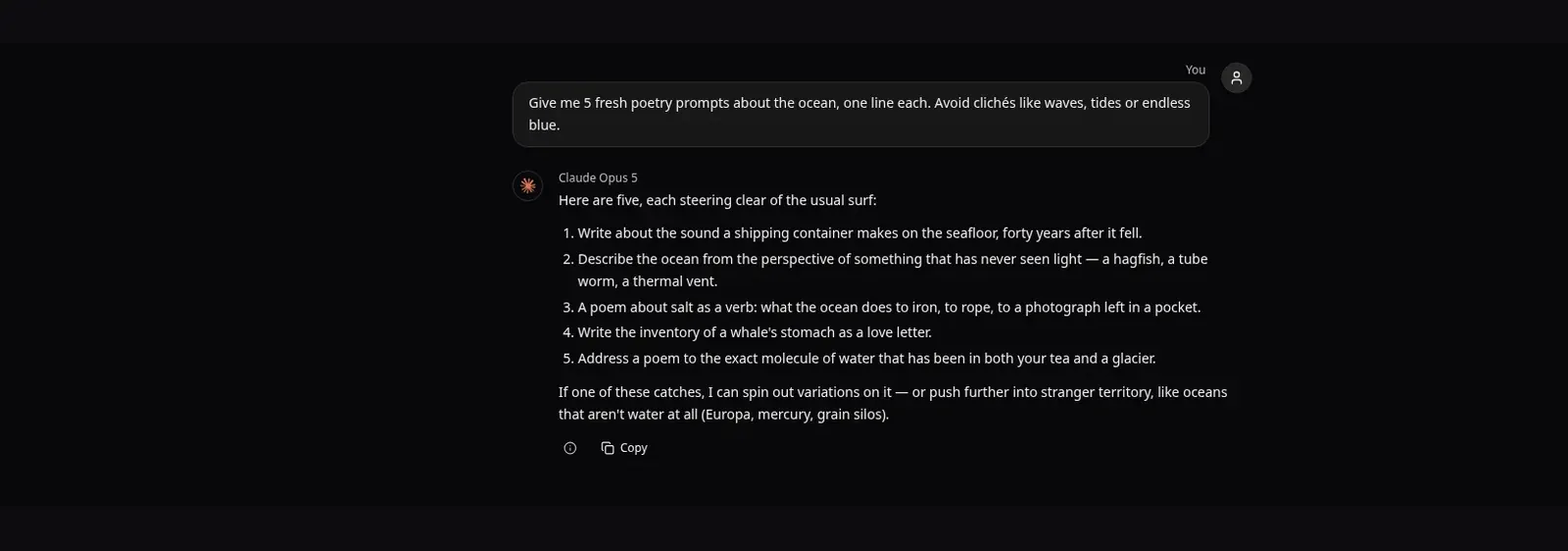
Paste this into Omnely Chat to warm up with the ocean brief featured at the top of this page:
Give me 5 fresh poetry prompts about the ocean, one line each. Avoid clichés like waves, tides or endless blue.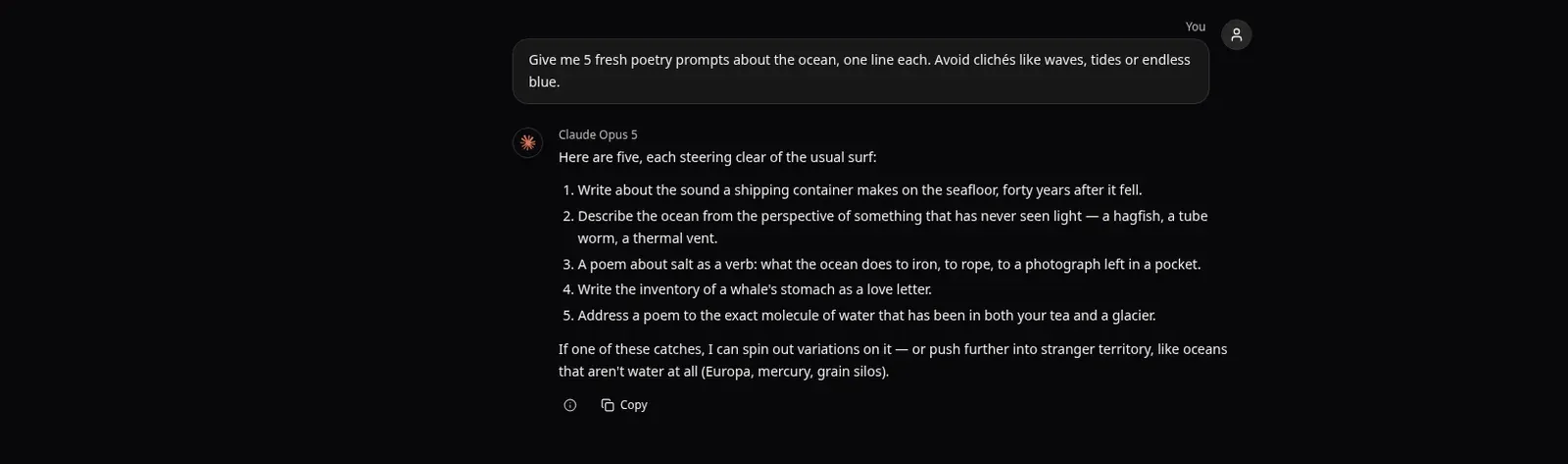
Claude Opus 5 returned five one-line ocean prompts, avoided the banned clichés, and offered variations — brainstorming, not a finished poem.
Try that prompt in Omnely Chat with Claude Opus 5, GPT-6 Astra, or Gemini 3.1 Pro — these chat models require a paid Omnely plan, and new users get free credits when they sign up.
Poetry prompts for every form and theme
Sixty original poetry prompts follow, grouped into six short sections so you can jump to a form or a mood. Each item is a seed — one or two sentences to start from, not a finished poem. Short form reminders are included where they help; everything else is up to you on the page.
Haiku, tanka, and other short forms
A haiku is traditionally three lines in 5-7-5 syllables and turns on a small, specific image. A tanka adds two more 7-syllable lines that respond to or complicate the image.
1. Write a haiku set at the exact moment a kettle starts to whistle in an empty house.
2. A haiku about a crow learning the shape of a new rooftop in spring.
3. Write a tanka in which the first three lines describe a found object, and the last two lines reveal who lost it.
4. Haiku: the smell of rain reaching a pavement that has not been rained on for forty-one days.
5. Write a senryu — haiku-shaped, but about human behavior — set at a self-checkout at 11:47 p.m.
6. A cinquain (2-4-6-8-2 syllables) addressed to a houseplant that has outlived two relationships.
7. Write a monostich (a one-line poem) that would still feel complete if someone found it on a bus ticket.
8. Tanka: a childhood bedroom repainted by someone who never lived in it.
9. Haiku sequence of three poems, each tied to a different sound your refrigerator makes.
10. Write a six-word poem that starts with the word "almost."
Sonnets, villanelles, and repeating forms
A sonnet is 14 lines (often iambic pentameter) that argues with itself and turns near the end. A villanelle is 19 lines with two refrains that come back on a schedule. A pantoum repeats whole lines in a chain.
11. Write a sonnet to the oldest piece of clothing you still wear, with the turn arriving when you admit why.
12. A villanelle whose first refrain is a street name and whose second refrain is a lie you keep telling about it.
13. Write a sonnet in the voice of a lighthouse that has just been automated.
14. Pantoum: four stanzas drawn from four photographs you have never shown anyone.
15. Write a villanelle about learning a second language in middle age, where the refrains are the two words you still mispronounce.
16. A Shakespearean sonnet whose final couplet is a recipe instruction.
17. Write a ghazal of five couplets, each ending in the word "later," on the subject of inherited patience.
18. A rondeau whose refrain is a text message you drafted and never sent.
19. Write a sonnet in which every line contains a color, and only the last line names one.
20. Triolet (8 lines, two repeating lines) spoken by a door that has started to stick.
Free-verse poems, list poems, odes, and elegies
Free-verse poems set their own rules. A list poem is built from a single running catalog. An ode praises; an elegy mourns — both work harder when the subject is small.
21. Write a free-verse poem that begins with the sentence "Used to know what this room was for."
22. A list poem titled "Everything the hallway light has seen this year."
23. Write an ode to the particular squeak of your front door.
24. An elegy for a shop that closed before you got to say goodbye to the person at the counter.
25. A free-verse poem in the second person, addressed to a stranger who once gave you directions you did not take.
26. Write a list poem of the sounds in your building between 2 a.m. and 3 a.m.
27. Ode to the back of a spoon.
28. Elegy for an email address you no longer use.
29. Write a free-verse poem in which the weather changes three times and the speaker does not move.
30. A found poem built only from words on the packaging in your kitchen cupboard.
31. Write an ode to a tool you own and have never once used correctly.
32. List poem: "Things the dog waits for."
Nature, memory, and everyday life
These prompts keep the lens close. Trust a single object or minute; let the poem find the rest.
33. Write about the exact shade of sky that appears ten minutes before a city thunderstorm.
34. A poem built around the first thing you ever learned to cook, and the person who was in the room.
35. Describe the inside of a bus shelter at the end of a long shift.
36. Write a poem about the smell of a library you used to visit, without using the word "paper."
37. A poem about a tree on your street that is slowly lifting a paving stone.
38. Write a poem in which a memory arrives in a scent you cannot name.
39. A poem about snow falling on an object that does not belong outside.
40. Write about the moment a familiar song comes on in a place it has no business being.
41. A poem set entirely inside the time it takes to boil an egg.
42. Write a poem addressed to the version of your hometown that only existed when you were nine.
People, love, and feelings
Specific detail outperforms big words. Give the reader a hand, a shoe, a Tuesday — not "sorrow."
43. Write a love poem that never uses the word "love" and contains at least one bus ride.
44. A poem to a friend you have stopped seeing by accident rather than by choice.
45. Write about the feeling of recognizing your parent's handwriting on an unexpected envelope.
46. A poem about being the second person to arrive at a party.
47. Write a poem in which anger is a houseguest who has overstayed, politely.
48. A poem to a sibling, structured as directions to a place only you two remember.
49. Write about the first time you forgave someone without telling them.
50. A poem about the quiet after laughing too hard in a public place.
51. Write a poem to someone you only ever met online, in the voice of the weather in their city.
52. A break-up poem that takes the form of a grocery list for one.
Beginner-friendly and classroom ideas
Short, concrete starters for new writers, students, and anyone warming up. Any of these also work as a five-minute journal exercise.
53. Write a four-line poem about what your name sounds like when a stranger says it.
54. An acrostic using the word WINDOW, where each line is something you have watched from one.
55. Write a poem that begins "If this backpack could talk, it would say…"
56. A poem built from five things in your pocket right now.
57. Write a color poem: pick one color and list five things that are that color in your home, then add one that isn't.
58. A shape poem (concrete poem) in the outline of something in your kitchen.
59. Write a question poem: six lines, each one a question, no answers.
60. A "small thanks" poem to an object at your school or workplace that never gets noticed.
Pick one. Set a 20-minute timer. Write a bad draft on purpose. Come back to it after a walk. The prompt is a doorway, not a cage.
For more prompt lists across writing, image, and video, see the AI prompts hub.
Draft with AI chat as a writing partner
Omnely Chat is where the drafting-partner part happens. The reader writes the poem. The model helps brainstorm, explain forms, ask discovery questions, and give feedback that respects the draft. Claude Opus 5, GPT-6 Astra, and Gemini 3.1 Pro all sit in the same picker; they require a paid Omnely plan, and new users get free credits to try them.
1. Brainstorming idea-starters
The ocean example at the top of this page is the pattern: ask for a small, constrained set of one-liners and tell the model which clichés to avoid. That keeps the ideas sharp and the writing yours.
2. Craft feedback that does not rewrite the poem
Paste a stanza and ask for specific notes, with explicit instructions not to rewrite. Models follow this kind of boundary well.
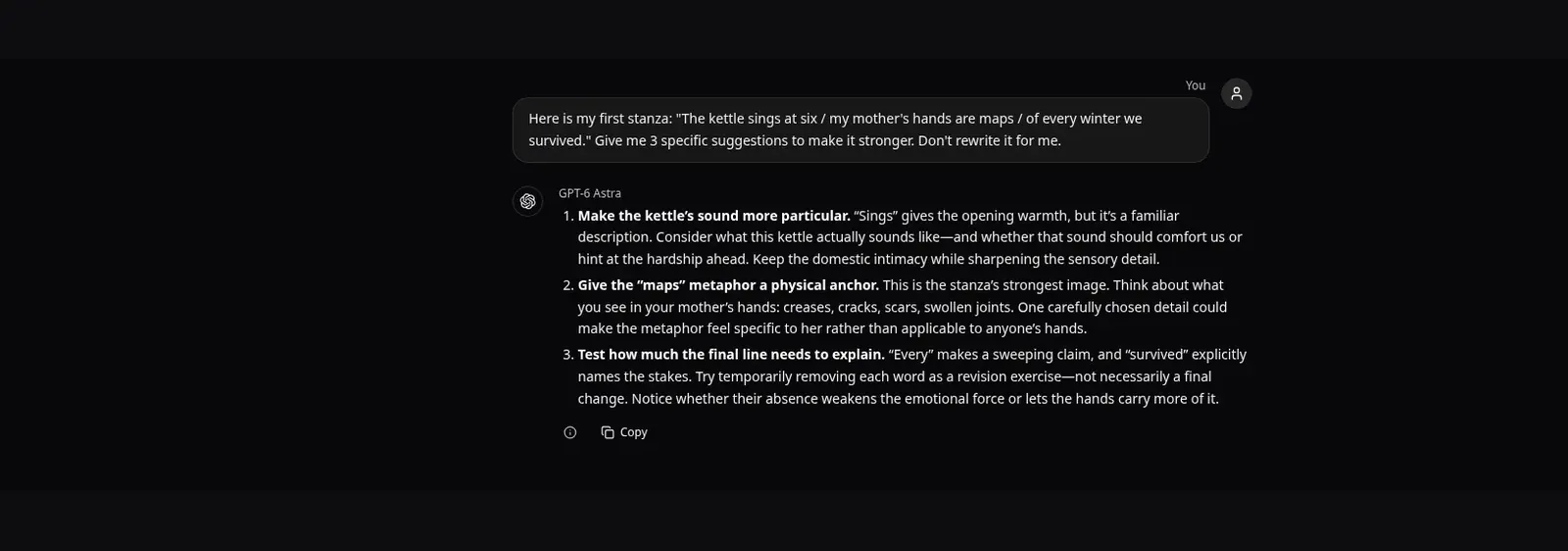
Here is my first stanza: "The kettle sings at six / my mother's hands are maps / of every winter we survived." Give me 3 specific suggestions to make it stronger. Don't rewrite it for me.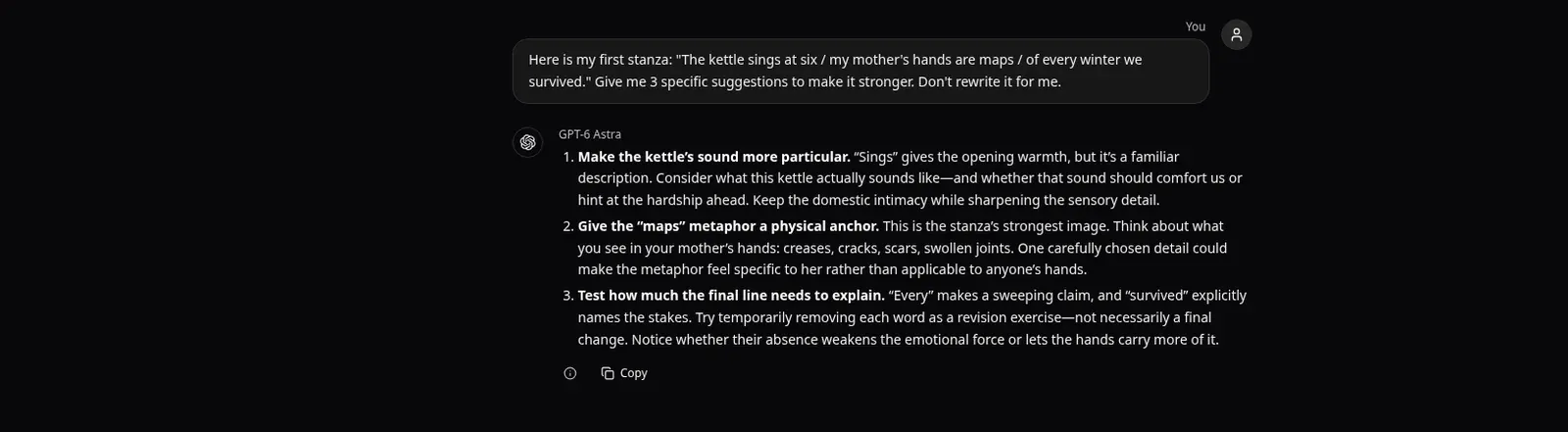
GPT-6 Astra gave three specific suggestions — sharpen the kettle's sound, anchor the "maps" metaphor to a physical detail, and test whether "every" and "survived" are doing too much — and did not rewrite the stanza.
3. Form rules plus one starter
When a form is unfamiliar, ask for the rules compressed into bullets, plus a single prompt that fits the form's natural strengths.
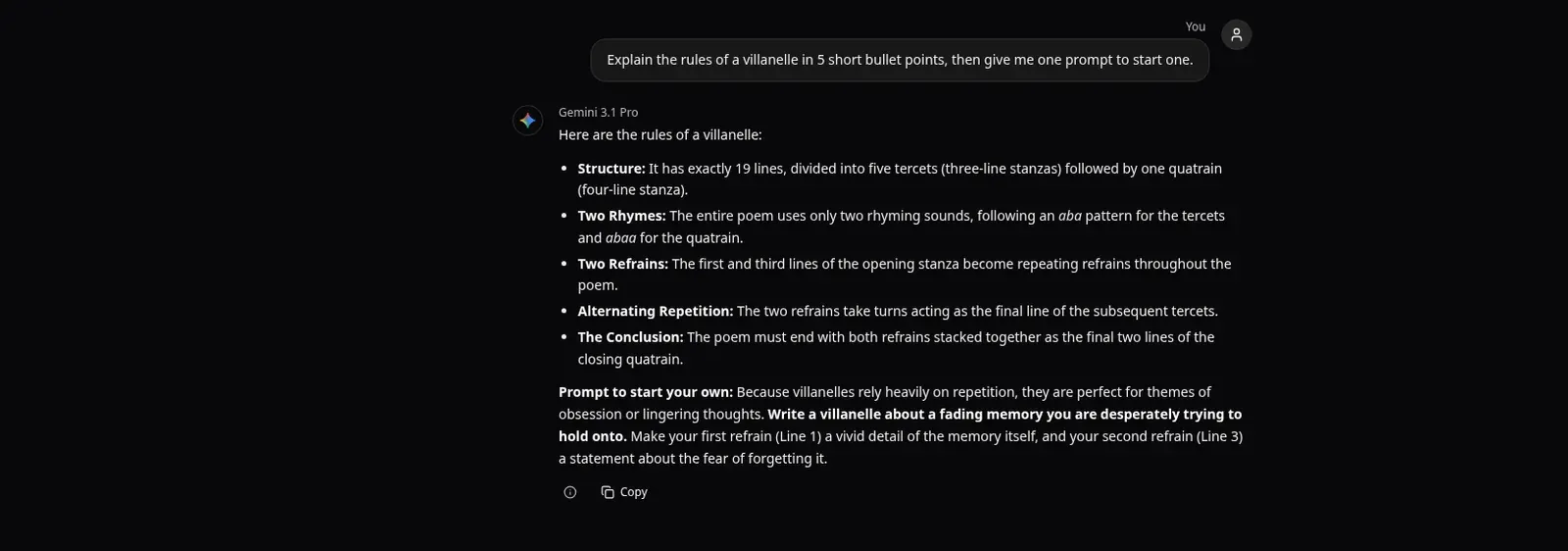
Explain the rules of a villanelle in 5 short bullet points, then give me one prompt to start one.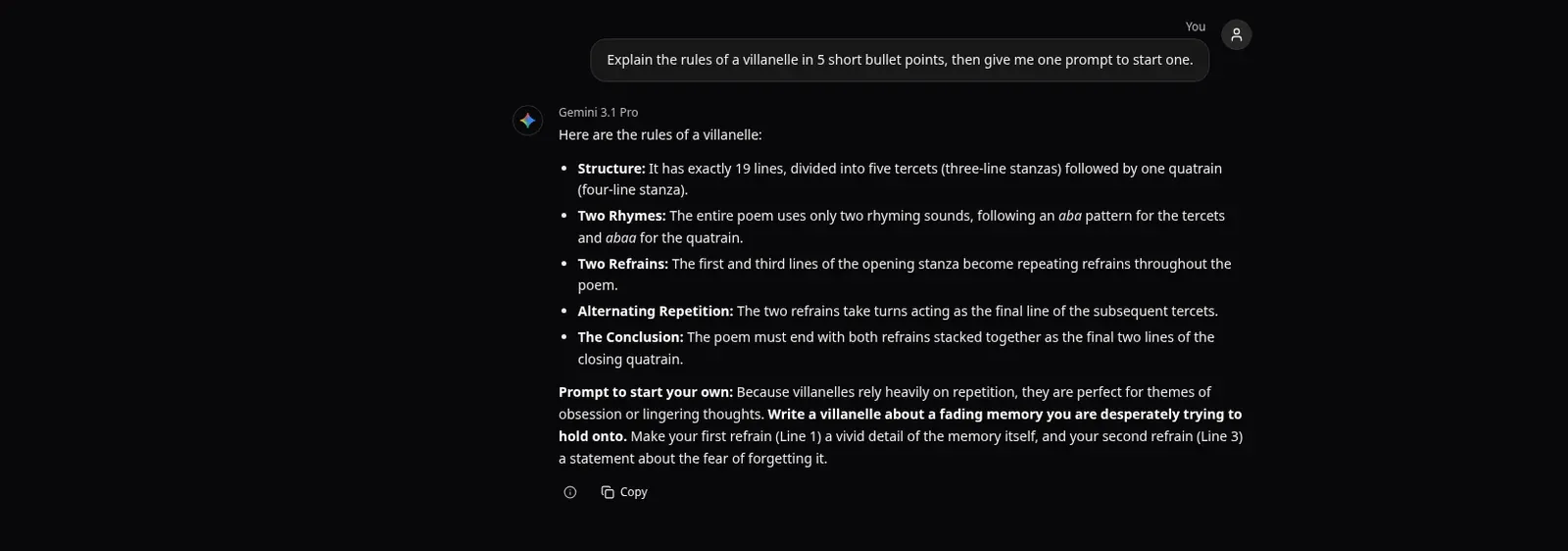
Gemini 3.1 Pro gave five villanelle-rule bullets — 19 lines, two rhymes, two refrains, alternating repetition, and both refrains stacked as the last two lines of the closing quatrain — and one starter prompt about a fading memory. It did not write a villanelle.
4. Discovery questions before a first draft
Instead of asking for the poem, ask for the questions that will give you better details to write from.
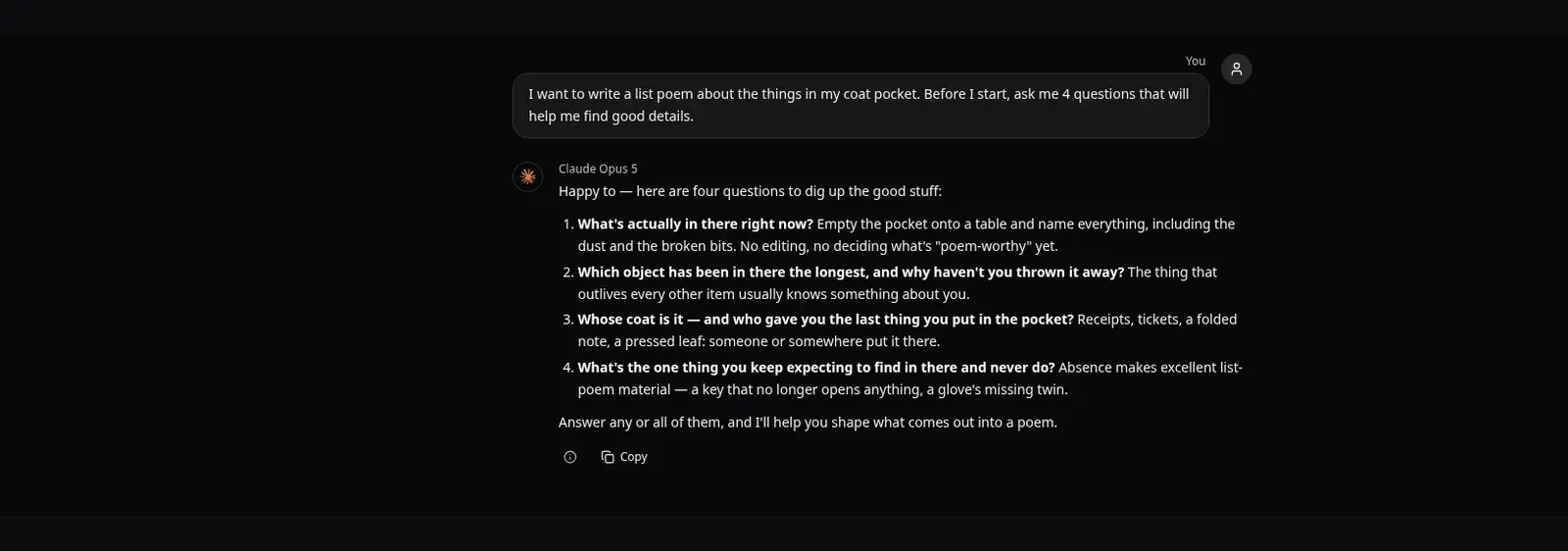
I want to write a list poem about the things in my coat pocket. Before I start, ask me 4 questions that will help me find good details.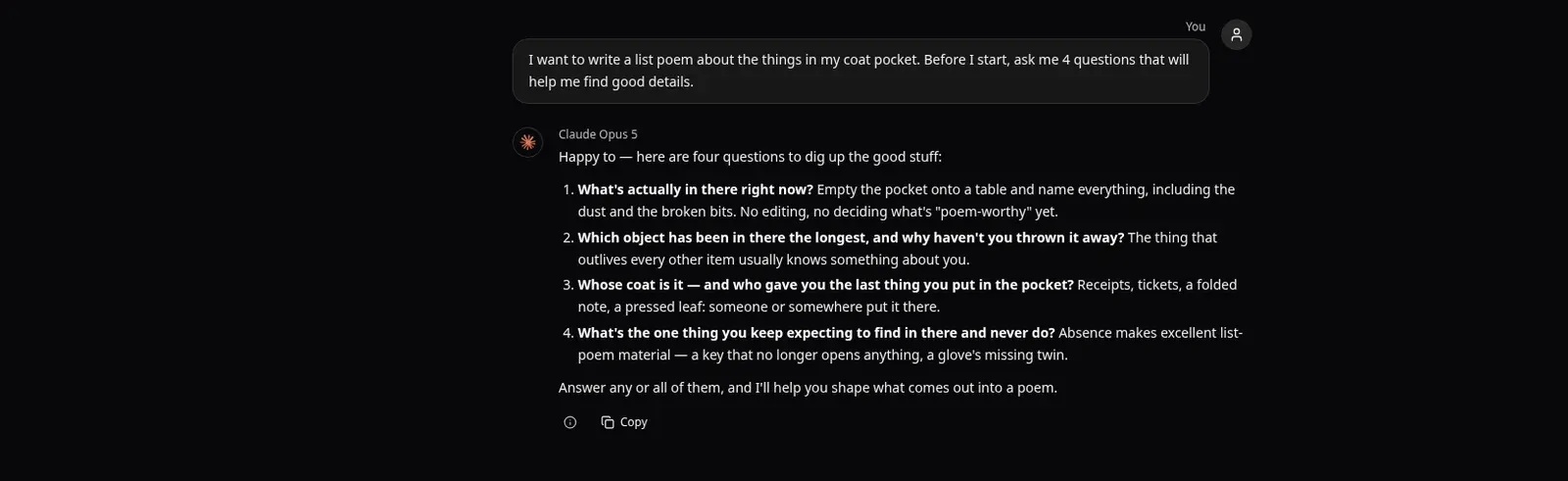
Claude Opus 5 asked four questions — empty the pocket, which object has lasted longest, whose coat and whose gift, what you keep expecting to find and never do. Its last line offers to help shape the reader's answers into a poem; that is a writing-partner offer, not a promise to write the poem.
A good rule: ask the model for ingredients, constraints, questions, and feedback. Write the lines yourself. The poem is better when the voice is yours.
Optional illustrations with Seedream 5.0 Pro and GPT Image 2
Once a poem exists, an illustration can live alongside it in a zine, a blog post, or a print. Both of these Omnely image models live in the same workspace as chat, so a finished draft can move into a visual pass without switching accounts.
- Seedream 5.0 Pro — photoreal text-to-image and image-to-image at 1K or 2K, with up to 10 reference inputs and no watermark. Useful when the poem calls for a specific photographic texture: a kitchen, a shoreline, a weathered coat.
- GPT Image 2 — text-to-image and image-to-image at 1K, 2K, or 4K with up to 16 references, no watermark. Useful when the poem suggests a stylized or editorial image that needs to carry type.
New users get free credits to try both. Illustration is a nice-to-have; the proof on this page is the chat work, not the images.
For a related writing form, the companion post on AI platforms for lyrics covers how song lyrics differ in structure and workflow from poems.
Poetry prompts FAQ
What is a poetry prompt?
A poetry prompt is a short, specific starting point — an image, a constraint, a question, or a form assignment — that gives you traction without dictating the poem. Good prompts narrow the field (one object, one minute, one color, one form) and leave the voice, the music, and the meaning to the writer.
Should the reader or the model write the poem?
The reader writes the poem. A chat model is useful for brainstorming prompts, explaining forms, asking discovery questions, and giving craft feedback — the tasks shown in the transcripts above. Asking the model to write the poem outright usually produces something competent and anonymous. Asking it to help you notice better details produces something only you could have written.
How should Omnely chat be used as a writing partner?
Four patterns cover most sessions: (1) ask for a small set of constrained idea-starters, (2) paste a stanza and ask for specific feedback with "don't rewrite the stanza," (3) ask for the rules of a form compressed to bullets plus one starter, (4) ask the model for questions that will help you find details before you write. Keep the drafting in a notebook or a doc; keep the chat for scaffolding.
How is writing a poem different from writing lyrics?
Lyrics are built for a melody and a repeating structure (verse/chorus/bridge), and they live inside a time signature. Poems set their own timing on the page. Many prompts here can seed either — a list poem about a coat pocket could become a verse — but the craft moves diverge quickly. The lyrics guide covers the song-specific side.
---
Pick one of the sixty ideas, or start with the ocean brief at the top. Open Omnely Chat, choose Claude Opus 5, GPT-6 Astra, or Gemini 3.1 Pro, and use the model to brainstorm, scope a form, or ask you better questions — then close the tab and write the poem yourself. A paid Omnely plan is required for these chat models; new users get free credits when they sign up.