Claude AI vs ChatGPT in 2026: Claude Opus 5 vs GPT-6 Astra, Same Prompt in One Chat
Compare Claude AI vs ChatGPT in one Omnely chat. Claude Opus 5 and GPT-6 Astra take the same four prompts: a Python bug, an invoice email, a logic puzzle, and a table.
Claude AI vs ChatGPT in 2026 comes down to this: Claude leans toward careful writing, structured code, and extra context; ChatGPT leans toward tight instruction-following and a broader toolkit of images, voice, and agents. Omnely puts both in the same chat window, so the same prompt can go to Claude Opus 5 and GPT-6 Astra without switching tabs or juggling two product accounts.



| Category | Claude (official app) | ChatGPT (official app) | In the Omnely chat picker |
|---|---|---|---|
| Flagship chat model | Claude Opus 5.5 (Nov 2026) | GPT-6 Astra (Sep 2026) | Claude Opus 5 and GPT-6 Astra |
| Writing / long docs | Core strength | Capable, broader toolkit | Both models, same thread |
| Coding assistant | Claude Code (official app) | Codex (official app) | Chat-based coding on both models |
| Image generation | Not in Claude chat | Image tools in ChatGPT | GPT Image 2 / 2.5 / 2.6 variants |
| Voice, live video, agents | Cowork / Artifacts (official app) | ChatGPT Work, Advanced Voice (official app) | Not in the Omnely picker |
| Workspace angle | One account per product | One account per product | Switch models mid-thread in /chat |
The quickest proof is the Python bug test. Here is the exact prompt:
This Python function crashes on an empty list. Find the bug and give a fixed version with a one-line explanation: def avg(nums): return sum(nums) / len(nums)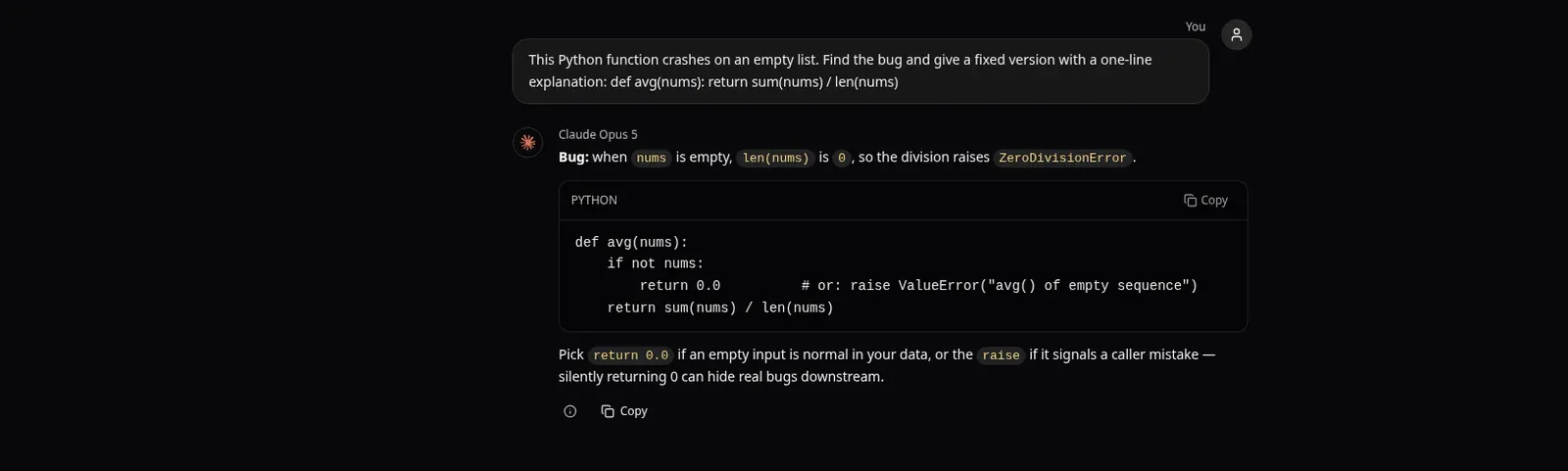
Claude Opus 5 on Omnely, 12 November 2026. It names the ZeroDivisionError, returns 0.0, and adds a longer explanation than the requested one line.

GPT-6 Astra on Omnely, 12 November 2026. A compact fix that returns None, plus a one-line explanation.
To run the same four prompts, open Claude Opus 5 or GPT-6 Astra in Omnely Chat; both flagships need a paid Omnely plan, and new users get free credits on signup.
Same prompt, two answers: Claude Opus 5 vs GPT-6 Astra
Both models find the same bug — dividing by len(nums) when nums is empty — and both return working Python. The style difference is clear in the screenshots above.
Claude Opus 5 names the exception by name ("ZeroDivisionError"), returns 0.0, and leaves a commented alternative (raise ValueError("avg() of empty sequence")) in the function body. The explanation runs past one line, closing with guidance on when to pick each branch: return 0.0 if empty input is normal, raise if it signals a caller mistake.
GPT-6 Astra writes a one-liner: return sum(nums) / len(nums) if nums else None, followed by a single sentence that calls the empty average "undefined". Shorter, tighter, follows the one-line instruction more literally.
Neither answer is wrong. Claude is giving a longer design nudge; GPT-6 Astra is giving the compact fix the prompt asked for.
Claude AI vs ChatGPT: models in the official apps and in Omnely
Third-party roundups from late 2026 (Zapier's October 2026 review, DataCamp's November 9, 2026 model-vs-model piece, and LearnLLM's November 6, 2026 update) name newer official-app models on both sides:
- Anthropic in the Claude apps: Claude Opus 5.5, Sonnet 5.5, Haiku 5.5, and Fable 5.2
- OpenAI in the ChatGPT apps: GPT-6 Astra, GPT-6 Luna, and GPT-6.1 Sol
Those are useful to know, but they are not the Omnely picker. The current Omnely chat lineup exposes Claude Opus 5 (anthropic/claude-opus-5, 1M context) as the visible Anthropic flagship, alongside Claude Fable 5.1, Sonnet 5, Opus 4.8/4.7/4.6, and Haiku 4.5. On the OpenAI side, GPT-6 Astra (openai/gpt-6-astra, 1.05M context) leads, with GPT-5.6 Sol, Terra, Luna, and GPT-5.5/5.4/5 behind it.
Claude Opus 5.5, Sonnet 5.5, Haiku 5.5, and Fable 5.2 are not in the Omnely picker. The sister post Claude vs Gemini makes the same note for Opus 5.5 and Gemini 4 Argon. For an inventory of the Claude tier structure and what each model is tuned for, see Claude pricing: plans, limits, and Claude Opus 5.
Official-app-only features such as Claude Code, Cowork, Artifacts, ChatGPT Work, Advanced Voice, and live video stay in their respective official apps.
Coding and technical work
The Python avg test above is the honest coding example. Both models identified the empty-list division-by-zero bug; the design difference is how they close it.
- Claude Opus 5 returned
0.0and kept araise ValueError(...)alternative in the function so the reader can pick a policy. - GPT-6 Astra returned
Noneon an empty list with a one-sentence rationale.
Agentic coding tools — Claude Code on the Anthropic side, Codex on the OpenAI side — are official-app features. They do not run inside Omnely chat. What Omnely covers is the chat-model side of coding: writing new functions, explaining bugs, refactoring, drafting tests, and reviewing diffs in one thread without switching providers.
Writing, tone, and long context
Prompt P1 asked for a warmer-but-firm rewrite in under 80 words:
Rewrite this message so it sounds warm but firm, in under 80 words: "Hi, your invoice is 30 days late. Pay now or we stop all work."
Claude Opus 5 on Omnely, 12 November 2026. A 73-word draft with [Name] and [#] placeholders, plus an offer of a shorter version.

GPT-6 Astra on Omnely, 12 November 2026. A 42-word draft with no placeholders, under the 80-word cap.
Claude Opus 5 delivered a 73-word draft with [Name] and [#] placeholders for the client name and invoice number, then offered a shorter, punchier version and a softer first-nudge variant. GPT-6 Astra delivered a 42-word draft with no placeholders — a single ready-to-send paragraph that uses the company voice and stays well under the 80-word cap.
Both land the tone brief. Claude is giving a template; GPT-6 Astra is giving a finished message.
Quick table test (P4)
Prompt P4 asked for a 4-row markdown table on focus, collaboration, cost, and flexibility, each cell under 8 words:
Make a 4-row markdown table comparing remote work vs office work on focus, collaboration, cost and flexibility. Keep each cell under 8 words.
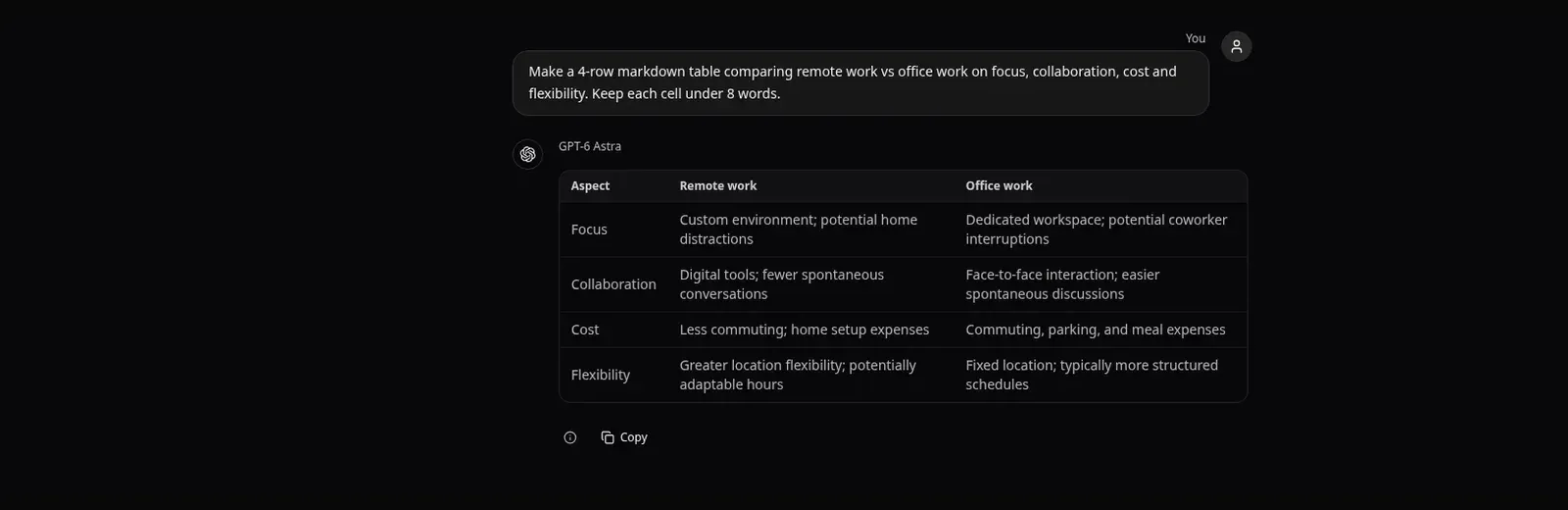
Claude Opus 5 on Omnely, 12 November 2026. A 4-row table; every cell is under 8 words. The screenshot is the proof.
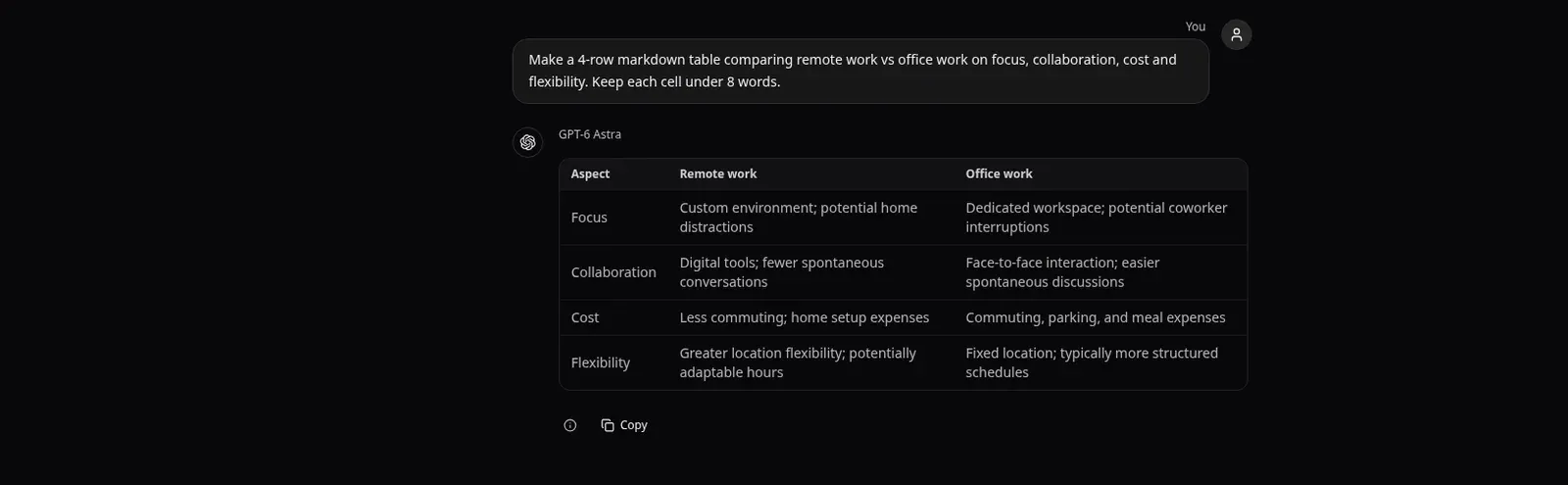
GPT-6 Astra on Omnely, 12 November 2026. A 4-row table with an Aspect header; every cell is under 8 words. The screenshot is the proof.
Both models returned exactly four rows on the requested factors. Every cell in both tables stays under the 8-word cap. Claude's row labels are Focus / Collaboration / Cost / Flexibility; GPT-6 Astra's header column is Aspect, with the same four factors as rows. Claude's cells read as single thoughts (e.g., "Fewer interruptions, but home distractions possible"); GPT-6 Astra's cells read as paired trade-offs separated by a semicolon (e.g., "Custom environment; potential home distractions").
Reasoning, research, and up-to-date answers
Prompt P3 is the classic bat-and-ball puzzle:
A bat and a ball cost $1.10 together. The bat costs $1.00 more than the ball. How much does the ball cost? Answer in 3 short lines.
Claude Opus 5 on Omnely, 12 November 2026. Correct math ($0.05 / $1.05 / $1.10), but one line instead of the requested three short lines.

GPT-6 Astra on Omnely, 12 November 2026. Also correct, and also one line rather than three short lines.
Both models answered correctly: ball $0.05, bat $1.05, together $1.10. The puzzle rewards models that don't shortcut past "$1.00 more than" — both got it right.
The prompt asked for the answer in three short lines. In both chats, the answer rendered on a single line rather than three line breaks: Claude's "Ball = $0.05. Bat = $1.05 (exactly $1.00 more). Together = $1.10. ✓" and GPT-6 Astra's "The ball costs $0.05 (5 cents). The bat costs $1.05—exactly $1.00 more. Together, they cost $1.10." Same math, same correct result, same partial miss on the exact line-break format.
Image and video
This is a chat post, so the receipts above are chat screenshots, not renders. Still, the Claude-vs-ChatGPT image split on Omnely is worth knowing:
- ChatGPT-side image models live on Omnely as GPT Image 2 (10 credits at 1K, 15 at 2K, 20 at 4K, up to 16 reference images) and GPT Image 2.5, which also covers GPT Image 2.6 variants. Both are reachable from the same account that runs chat.
- Claude-side image generation is not a separate model in the Omnely picker. Claude in Omnely is a chat-and-reasoning model.
For a broader picture of how Omnely stacks up as a general-purpose Chat replacement, see best ChatGPT alternative for chat, image, and video.
Using Claude and ChatGPT in one Omnely workspace
The main Omnely angle: Claude Opus 5 and GPT-6 Astra sit in the same model picker. One chat thread can switch between them on each turn — ask Claude Opus 5 for a nuanced writing pass, then flip the same question to GPT-6 Astra to see a tighter draft, without opening a second product.
Gemini and Grok ride in the same picker (Gemini 3.1 Pro, Gemini 3.6 Flash, Grok 4.6, Grok 4.3), so four-way tests are possible too. Sister posts cover those pairs: Gemini vs ChatGPT and Grok vs ChatGPT.
Claude Opus 5 and GPT-6 Astra both require a paid Omnely plan. New users get free credits on signup to try prompts like the four used above before committing to a plan.
Which should you pick?
Not one single winner — these four prompts split along predictable lines:
- Instruction-following and brevity: GPT-6 Astra came in tighter. The 42-word invoice rewrite (vs Claude's 73), the one-line Python fix returning
None, and compact table cells all favored GPT-6 Astra on the exact wording of the request. - Structure, options, and extra guidance: Claude Opus 5 added placeholders, offered alternate versions, named the exception by its Python class, and commented a second code branch so the reader can choose a policy. More scaffolding, more words, more optionality.
- Reasoning accuracy: Even on the bat-and-ball trap. Both correct.
- Format compliance on cosmetic asks: Both missed the "3 short lines" line-break instruction and compressed the answer onto one line.
A reasonable workflow is to default to Claude Opus 5 for drafting and decision-support work, default to GPT-6 Astra when the prompt sets a word cap or a specific output shape, and keep both one click apart in the same workspace.
Claude AI vs ChatGPT FAQ
Which model is better for coding on Omnely?
Both Claude Opus 5 and GPT-6 Astra handle everyday Python, JavaScript, SQL, and shell tasks in chat. Claude Opus 5 tends to add more context around the fix — alternative branches, design guidance, named exceptions. GPT-6 Astra tends to return the shortest working change. The same bug can be run through both in one Omnely thread.
Does Omnely have Claude Opus 5.5 or Claude Fable 5.2?
No. The Omnely chat picker currently shows Claude Opus 5, Claude Fable 5.1, Claude Sonnet 5, Claude Opus 4.8 / 4.7 / 4.6, and Claude Haiku 4.5. Opus 5.5, Sonnet 5.5, Haiku 5.5, and Fable 5.2 are official-app / API releases on Anthropic's side and are not available in Omnely.
What about Claude Code, Cowork, Artifacts, ChatGPT Work, or Advanced Voice?
Those are official-app features of Claude and ChatGPT. Omnely covers the chat side of both: one picker, one thread, Claude Opus 5 and GPT-6 Astra next to Gemini 3.1 Pro, Grok 4.6, and dozens more. Image and video work happen on separate Omnely model pages.
Can the two models share a conversation?
Yes. In Omnely Chat, each turn can select a different model, so one thread can collect a Claude Opus 5 answer and a GPT-6 Astra answer to the same prompt side by side — the same setup used to collect the screenshots in this post.
---
Open Omnely Chat, pick Claude Opus 5 or GPT-6 Astra, and paste the four prompts above (invoice rewrite, Python avg bug, bat-and-ball puzzle, remote-vs-office table) to see the same split on real work. A paid Omnely plan is required for these flagship models, and new users get free credits on signup.